
High school biology taught us that the mitochondrion is “the powerhouse of the cell.” While factually accurate, that cliché drastically understates the reality. Mitochondria are not native cellular equipment. They are former free-living invaders turned domesticated cellular power plants.
Mitochondria represent evolution’s most brilliant metabolic bargain, but their evolutionary origin is precisely why they become the ultimate bottleneck in human health and longevity.
To understand why these microscopic organelles dictate whether you thrive at age 80 or succumb to chronic disease at 50, we have to look past simple biology. We need to explore planetary history, quantum biophysics, and the fundamental laws of energy.
1. The Cosmic Merger: A Biological Hijack
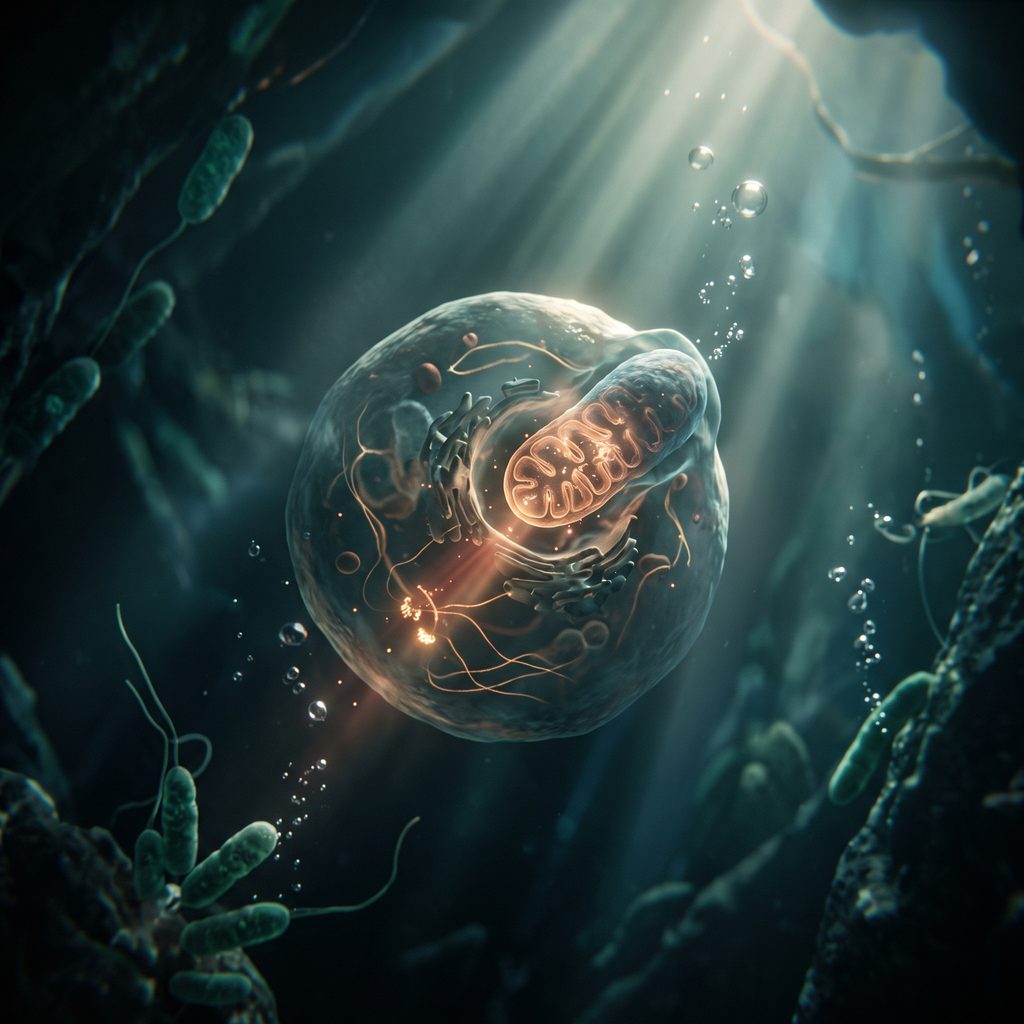
Roughly 1.5 to 2 billion years ago, Earth was inhabited exclusively by simple, single-celled life. In a random twist of evolutionary fate, an ancient single-celled host organism (essentially a primitive cellular landlord) swallowed a wild, oxygen-breathing microbe.
Instead of digesting the intruder, the host formed a permanent, mutually beneficial union with it—a biological rooming agreement known as endosymbiosis. The primitive host provided shelter, physical protection, and a steady supply of carbon-based raw nutrients. In return, the engulfed microbe unlocked a radical new superpower: the ability to process oxygen to yield high-octane cellular energy. This single event was life as we know it, just being created. This is the beginning of the story, of Mitochondria and Me.
2. Planetary Physics: Adaptations to Light, Oxygen, and Earth’s Rhythm
This cosmic merger did not happen in a vacuum. It was driven directly by the physical environment of early Earth:
- The Great Oxidation Event: Cyanobacteria (primitive plants in a way, that produce oxygen) had flooded the atmosphere with toxic oxygen, creating an environmental crisis for early organisms that could not use this oxygen for any good purpose. The early ancestor of the mitochondrion evolved specific machinery to capture this reactive oxygen gas and turn it into a high-energy electron sink. This was a phenomenal advantage for the organism and any friends it would form a mutual relationship with, like us. By housing this microbe, the host could transform an atmospheric toxin into an explosive source of cellular fuel.
- Solar Infrared & Light Adaptation: Mitochondria evolved to interact directly with solar radiation. Specific light-absorbing proteins inside the inner mitochondrial membrane absorb long-wave near-infrared light from the sun. This light exposure physically alters mitochondrial enzymes, displacing inhibitory gases like nitric oxide and boosting energy production. They have essentially evolved to be optimised for exposure to sunlight.
- Circadian Entrainment: Because Earth rotates every 24 hours, mitochondria adapted to a strict light-dark rhythm. Their repair cycles, fusion-fission dynamics, and energetic output are synchronized with Earth’s daily light patterns. You can imagine then what living as we do now, disconnected to these natural light rhythms through artificial light exposure, can do to our health and biology. More in this in a later article!
3. The Evolutionary Dividend: Unlocking Complex Life
Before this biological merger, life was trapped in a severe energetic bottleneck. Primitive single-celled organisms were forced to generate energy across their outer cell membrane, strictly limiting how large they could grow and how complex their genetic code could become.
Internalizing thousands of tiny bacterial power plants changed the economics of life forever:
- The ATP Cash Flow: Offloading energy generation to internal organelles yielded an astronomical bump in cellular currency. Primitive fermentation of fuel without oxygen produces a meager 2 units of ATP (adenosine triphosphate, the universal chemical cash required to fund every cellular action in your body). Aerobic respiration inside the mitochondrion cranks that output up to 30 to 32 ATP units—a more than 15-fold efficiency upgrade.
- Funding Complex Architectures: This massive energetic surplus provided the exact financial backing needed to expand the cell’s genetic library by orders of magnitude. Cells could finally afford the energy needed to copy, repair, and translate vast new genomes.
- The Multicellular Revolution: With this vast increase in energy per gene, life could “pay” for specialized cellular machinery, tissue differentiation, complex organ systems, expanding brains, and ultimately, human beings.
4. Inside the Bio-Engine: The Electron Transport Chain
To appreciate how mitochondria generate this energetic windfall, we have to look inside their inner membrane at the Electron Transport Chain (ETC).
The entire process operates like a microscopic hydroelectric dam. High-energy electrons harvested from carbohydrates and fats are delivered by molecular shuttles (NADH and FADH₂) directly to the front of a specialized assembly line.
This assembly line consists of four major protein structures (Complexes I through IV). Electrons pass through these complexes and as these electrons jump down the relay line, the liberated energy is used to pump protons (hydrogen ions) across the inner membrane into a reservoir space. This movement builds a massive electrical and chemical pressure gradient across a tiny membrane only a few nanometers thick, generating a voltage gradient equivalent to a microscopic bolt of lightning. This is why we can call ourselves electrical beings!
With nowhere else to go, those trapped protons rush back through a microscopic rotary motor called ATP Synthase. This protein motor physically spins at up to 9,000 RPM, mechanically slamming ADP and phosphate together to mint fresh ATP cash at rates of hundreds of molecules per second. At the very end of the line, oxygen acts as the ultimate electron drain at Complex IV, catching spent electrons and protons to form harmless water. If oxygen is absent, the assembly line backs up instantly, the dam gradient collapses, and cellular energy generation grinds to a sudden halt.
5. Built-In Flaws: The Dark Side of the Deal
Evolution is a master of trade-offs, not absolute perfection. In exchange for high energy production, human cells inherited severe structural liabilities that ultimately dictate our healthspan and lifespan:
- Corrosive Exhaust (ROS Generation): Converting oxygen into usable energy is chemically volatile. As fuel moves down the assembly line, electrons occasionally escape (primarily at Complexes I and III) and react prematurely with oxygen, forming reactive oxygen species (ROS)—volatile chemical sparks. These are the “oxidants” to your “anti-oxidants” you have all heard of. Low bursts of ROS act as vital signalling cues for repair (an adaptive biological stress response called hormesis). However, chronic ROS leakage steadily chars surrounding proteins, lipids, and delicate cellular structures over time. Read our previous article on oxidative stress here.
- Unprotected DNA in the Blast Zone: When the ancient merger occurred, mitochondria retained a tiny ring of their own ancestral genetic code (mtDNA) encoding 13 core proteins of their internal power grid. Unlike nuclear DNA, which sits safely inside a shielded nucleus wrapped in protective histone proteins, mtDNA sits right next to the exhaust pipe described above, where explosive ROS are produced. Lacking robust repair machinery, mtDNA accumulates mutations 10 to 100 times faster than nuclear DNA.
- The Maternal Bottleneck: Mitochondria are inherited almost exclusively through the maternal egg, bypassing the genetic shuffling of sexual reproduction. Without a way to remix the genetic deck, it is exceptionally difficult for natural selection to filter out low-level mitochondrial defects across generations.
- Nature’s Short-Term Warranty: Natural selection optimized mitochondrial performance for peak energy and reproductive success in early adulthood. This concept—known as antagonistic pleiotropy—explains why evolution never selected for long-term repair mechanisms designed to sustain high-voltage power output across an 80-year human lifespan.
6. Bioenergetics, Entropy, and Human Disease
To understand why mitochondrial decline underpins nearly every major chronic disease, we have to step away from basic biology and look to fundamental physics.
The Second Law of Thermodynamics dictates that the universe naturally moves toward chaos, decay, and disorder (entropy) unless energy is continuously supplied to maintain order. Living human bodies are anti-entropy engines. We stay alive and healthy by constantly spending energy to rebuild broken proteins, clear out cellular garbage, repair damaged DNA, and maintain delicate internal balances (homeostasis).
Every single one of these homeostatic repair crews demands a steady, non-negotiable payout of ATP.

When your ATP production is high, the cell can continuously fund tissue repair, maintain strict cellular order, and stave off disease. However, when your mitochondria falter and cellular cash flow drops, the body can no longer pay the energetic tax required to stave off internal chaos. Homeostasis fails, cellular garbage accumulates, and chronic conditions—from heart failure and metabolic disease to neurodegeneration—emerge. These conditions are not random, isolated accidents; they are downstream manifestations of a biological power grid running out of fuel to keep entropy at bay.
Next week, in Part 2 of our series, we will step deeper inside the cellular grid to explore energy as the central variable of health—diving into how bioenergetics fails, what happens when metabolic flexibility collapses, and why cellular power dictates healthspan.