
If exercise were a pill, it would be the most powerful drug known to mankind. But if there were a runner-up for that title, it might just be doing absolutely nothing – at least, when it comes to eating. Fasting is currently having a moment. From Silicon Valley tech executives to ancient spiritual traditions, everyone seems to have an opinion on when you should (and shouldn’t) eat. But beyond the hashtags and the hype, what is actually happening inside your cells when you close the kitchen window?
At its simplest, fasting is the voluntary abstinence from calories. It is distinct from starvation, which is involuntary. Fasting is a controlled stressor, and like exercise, when done right, it is a powerful form of hormesis. This is the biological phenomenon where a short-term stressor—like a transient shortage of oxygen or energy—triggers a cellular response that makes the body stronger and more resilient.
But to understand why fasting works, we have to look back at where we came from.
The Evolutionary Mismatch: Why We Are Built for Famine and Fasting

Humans evolved to survive scarcity. For 99% of our history, there were no 24-hour supermarkets or delivery apps. We possess “thrifty genes” selected to help us store energy efficiently as fat to survive periods of famine.
Evolution, unfortunately, does not care about your longevity; it only cares about getting you to reproductive age. The very mechanisms that kept our ancestors alive—like limitless fat storage—are now driving a pandemic of metabolic disease in our modern environment of constant caloric excess. This is a classic case of something called antagonistic pleiotropy: genes that are beneficial in youth (for growth and survival) become detrimental in later life.
Fasting essentially mimics the ancestral environment our genes “expect,” potentially correcting the mismatch between our biology and our modern lifestyle.
The Fasting Timeline: A Journey Through Your Body on a Fast
Fasting isn’t a simple on/off switch. It is a continuum of biological shifts that occur the longer you go without food. Here is the deep-dive timeline of your physiology, from the moment you put down your fork to a full week of fasting.
0–12 Hours: The Fed State & Digestion
In the first few hours, your body is processing your last meal. Insulin levels are elevated, instructing your cells to absorb glucose and store energy.
- The Shift: Around the 12-hour mark (depending on your metabolic health), insulin drops significantly. This is the “all clear” signal for your body to stop storing fat and start releasing it. This ability to toggle between burning glucose and burning fat is known as metabolic flexibility, a hallmark of a longevity-supporting metabolism.
- Intermittent Fasting: You will notice most of the more profound benefits of fasting like autophagy and microbiome and immune system effects don’t kick in here until way further down the line. With this in mind, the benefits of popular “intermittent fasting” protocols where the fasting window is around or below 12 hours are achieving benefits largely on the basis of weight loss, which is by making it easier to create a small caloric deficit daily.
12–18 Hours: The Metabolic Switch & AMPK
Your liver runs out of glycogen (stored sugar). The body must now pivot.
- Lipolysis: You begin breaking down fat cells to release fatty acids.
- The Sensor: A critical protein called AMPK (AMP-activated protein kinase) kicks in. Think of AMPK as your car’s low-fuel warning light. When it senses energy is low, it suppresses energy-consuming processes (like building new proteins) and switches on genes that help you burn fat more efficiently.
16–24 Hours: The Microbiome Reset & The “Cleaning Crew”
While your cells are switching fuels, your gut is waking up its internal housekeeping service.
- The Cleaning Crew (MMC): When you are eating constantly, a process called the Migrating Motor Complex (MMC) is suppressed. This is a wave of electrical activity that sweeps through your intestines to clear out debris and excess bacteria. It only activates when the gut is empty. Fasting allows this “night sweeper” to finally do its job, preventing bacterial overgrowth in the small intestine (SIBO) and reducing bloating.
- Selective Resilience: Just as fasting makes your cells stronger, it pressures your microbiome. “Sugar-loving” pathogenic bacteria starve, while beneficial species like Akkermansia muciniphila—which can survive by eating the gut’s mucus lining—thrive. This shift strengthens the gut barrier, reducing “leaky gut” and the systemic inflammation that drives aging.
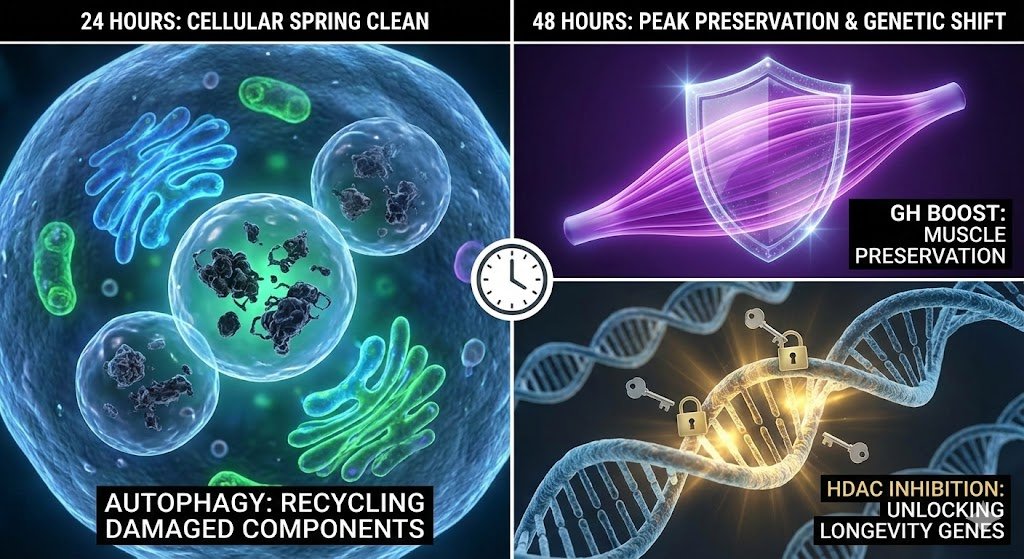
24 Hours: The Cellular “Spring Clean” (Autophagy)
By the one-day mark, your cells realize no new building materials are coming.
- Autophagy: This literally translates to “self-eating.” Your cells begin to scavenge old, damaged proteins and dysfunctional components to recycle them for energy.
- The Human Nuance: Important Note: Most of the “24-hour autophagy” data comes from mice. In humans, because of our slower metabolic rate, this process likely begins here but ramps up significantly later.
48 Hours: Peak Preservation & The Epigenetic Shift
This is often considered the “sweet spot” for deep cellular repair.
- Growth Hormone (GH): Counter-intuitively, GH levels often pulse upward during this phase. Why? To preserve lean muscle mass. The body is smart; it wants to burn fat for fuel, not the muscle you need to hunt for your next meal.
- HDAC Inhibition: HDAC stands for histone deacetylase, which if I were to anthropomorphise, is a guy that goes around and “tightens up” the structure of DNA so that it blocks genes from being read and expressed. As you burn fat, your liver produces ketones. Ketones aren’t just fuel; they are signalling molecules that can inhibit HDAC, which results in the “un-blocking” of longevity genes (like FOXO3a) that boost stress resistance.
72 Hours: The Immune Reset
At three days, the body enters a deep state of conservation and regeneration.
- Immune System Reboot: Prolonged fasting breaks down old, inefficient white blood cells (reducing immunosenescence).
- Stem Cell Activation: Upon refeeding, this void triggers hematopoietic stem cells to regenerate a fresh, more robust immune system.
Who Benefits Most from Fasting? The Clinical Applications
While the general longevity benefits are exciting, specific medical conditions show the most profound response to prolonged fasting.
1. Type 2 Diabetes & Metabolic Syndrome
This is the slam dunk. Type 2 diabetes is arguably a disease of “energy toxicity”—too much fuel jamming the cellular machinery.
- The Evidence: Clinical trials (such as the DiRECT trial published in The Lancet) have shown that aggressive caloric restriction can put Type 2 diabetes into remission by stripping fat from the liver and pancreas, allowing beta-cells to recover function.
- The Mechanism: Fasting lowers fasting insulin and restores insulin sensitivity. It addresses the root cause—visceral fat accumulation—rather than just managing symptoms.
- Caution: If you are a diabetic taking mediation that can drop your blood glucose, it is important to consult with a doctor around how to safely use fasting as a tool for your condition and health.
2. Cancer Adjunct Therapy
Fasting is emerging as a powerful partner to chemotherapy.
- Differential Stress Resistance: Fasting puts healthy cells into a “shielded” maintenance mode. Cancer cells, which are biologically wired to grow at all costs, cannot adapt to this lack of fuel.
- The Benefit: Research suggests fasting before chemotherapy can reduce toxicity (less nausea, fatigue, and bone marrow suppression) in healthy cells while potentially making cancer cells more vulnerable to the treatment.
3. Hypertension (High Blood Pressure)
Before we had effective drugs, fasting was the primary treatment for severe hypertension.
- The Evidence: Studies on medically supervised water-only fasting have shown massive reductions in systolic blood pressure—often enough to normalize pressure in stage 2 hypertensive patients.
- The Mechanism: It likely works through a combination of natriuresis (dumping sodium), dropping insulin levels (which causes kidneys to hold salt), and resetting the autonomic nervous system.
4. Neurodegenerative Disease (Alzheimer’s & Parkinson’s)
These conditions are often characterized by the accumulation of “junk” proteins (like amyloid plaque or alpha-synuclein) in the brain.
- The Hope: Since autophagy is the primary mechanism for clearing intracellular debris, fasting is being investigated as a way to “clean the brain.” While human trials are still early, animal models consistently show that intermittent fasting can delay the onset of neurodegeneration and improve cognitive function.
Fasting Mimetics: Can You Cheat the System?
Let’s be honest: not eating for three days is hard. It is biologically expensive, socially isolating, and frankly, unpleasant. This has led geroscience researchers to hunt for “Fasting Mimetics”—compounds that trigger these same beneficial pathways without the starvation.
Two compounds currently dominate the conversation: Rapamycin and Metformin. While they show immense promise, they are not without significant trade-offs.

1. Rapamycin: The Gold Standard Fasting Mimetic
Rapamycin is arguably the most exciting molecule in longevity science. Discovered in the soil of Easter Island, it is a compound that directly targets mTOR.
- The Mechanism: You can think of mTOR as the “General Contractor” of the cell. When nutrients are available, mTOR is ON. It instructs the cell to build, grow, and divide. When nutrients are scarce (fasting), mTOR turns OFF, and the cell switches to “repair mode” (autophagy). Rapamycin chemically flips this switch to OFF, tricking the body into thinking it is fasting.
- The Paradox: “Benevolent Pseudo-Diabetes” Here is the catch. Rapamycin mimics fasting so well that it can actually cause your blood sugar to rise, looking like diabetes on a lab test. Why?
- The Starvation Signal: The liver thinks the body is starving, so it pumps out glucose to save the brain.
- Insulin Resistance: Muscles stop accepting glucose to save it for the brain. Dr. Mikhail Blagosklonny calls this “Benevolent Pseudo-Diabetes“—the numbers look high, but the cells are actually healthy and protected, unlike true diabetes where cells are damaged by excess energy.
- The Nuance: mTORC1 vs. mTORC2 The goal of longevity is to inhibit mTORC1 (which controls aging and autophagy). However, if you take Rapamycin daily at high doses, you also eventually inhibit mTORC2. Inhibiting mTORC2 is what causes true insulin resistance and immune suppression. The Agami Take: This is why longevity protocols often use pulsed dosing (e.g., once weekly). The goal is to hit mTORC1 to trigger repair, then back off to let mTORC2 keep your metabolism and immune system healthy.
2. Metformin: The “OG” Diabetes Drug
Metformin has been used safely for decades to treat Type 2 Diabetes, but recent data suggests it might have broader anti-aging properties.
- The Mechanism: Metformin acts as a mild metabolic poison. It inhibits Complex I in the mitochondria (the powerhouse of the cell). This reduces the cell’s ability to produce energy (ATP) efficiently. This drop in energy is sensed by AMPK—the same “low fuel” sensor activated by fasting and exercise. AMPK then upregulates glucose uptake and fatty-acid oxidation to restore balance.
- The Benefit: It lowers blood sugar, improves insulin sensitivity, and reduces cancer risk in diabetic populations. It essentially creates a “biochemical fast.”
- The Trade-off (The Exercise Conflict): While excellent for diabetics, the data for healthy, active individuals is murky.
- Blunting Exercise Adaptations: Exercise works by creating stress (oxidative stress and mitochondrial demand) that forces the body to adapt. Metformin also creates mitochondrial stress. When you combine them, you might think you get a double benefit. Instead, studies suggest Metformin may prevent the body from adapting to the exercise stimulus. It effectively “blunts” the improvements in VO2 max and mitochondrial density you would normally get from training.
- Lower Testosterone: Some evidence suggests long-term use can lower testosterone levels, which is counter-productive for maintaining vitality and muscle mass.
- The Nuance: If you are sedentary and insulin resistant, metformin can provide a net benefit. If you are active, fit, and training for longevity, it might actually be downgrading your performance.
The Risks: Why Fasting Isn’t For Everyone
Before you lock the pantry or reach for the mimetics, we must address the risks. Just like exercise, the dose matters. Too low and the body will not be pushed to adapt. Too high and the result is damage or harm.
1. Muscle Loss (Sarcopenia)
This is the single biggest risk of aggressive fasting, and frankly, it is the one most influencers ignore.
- The Reality: Sarcopenia is the age-related loss of muscle mass and function. It is not just about looking good in a t-shirt; muscle is your “metabolic body armour.” It is the largest disposal site for glucose in the body and a critical reserve of amino acids for the immune system.
- The Mortality Link: We know that for individuals over 65, a fall resulting in a hip fracture carries a mortality rate of up to 30% within one year (this is greater than after having a heart attack). If you fast yourself into frailty, you are trading a lower risk of diabetes for a higher risk of a fatal fall.
- The Biological Conflict: Muscle is metabolically expensive tissue. In an evolutionary context, if you are starving (fasting) and not using your muscles to hunt, the body sees that muscle as an unnecessary luxury. It will break down muscle tissue into amino acids to create glucose for the brain (gluconeogenesis) before it fully switches to burning fat.
- The Nuance: Fasting inhibits mTOR (the growth pathway). To maintain muscle, you need mTOR to be active. If you are constantly fasting and never spiking mTOR with protein, you are in a perpetual state of breakdown (catabolism).
The Solution: You can fast and keep your muscle, but you have to send a loud signal to your body that this tissue is essential.
- Lift Heavy Things: You simply cannot be sedentary and fast. You must provide a mechanical stimulus—resistance training—to tell the body, “I need this muscle to survive.”.
- Feast on Protein: When you break your fast, you must prioritize high-quality protein (specifically the amino acid Leucine) to aggressively stimulate protein synthesis. You need to oscillate between the scarcity of the fast and the abundance of the refeed.
- Don’t Fast if Frail: If you are already in the bottom quartile for muscle mass, the longevity benefit of fasting does not outweigh the risk of further atrophy. Focus on building strength first.
2. Hormonal Stress & Sex Hormones
Fasting raises cortisol. It has to—cortisol is a “mobilization hormone” that helps pull stored energy out of your cells. But chronic cortisol elevation is a problem; it drives inflammation and erodes telomeres.
- For Women: Female physiology is exquisitely sensitive to energy availability. Your brain has a sensor (specifically kisspeptin neurons in the hypothalamus) that constantly monitors your energy balance. Aggressive fasting can trigger a “famine” alarm, causing the body to shut down “expensive” processes like fertility. This can lead to irregular cycles (amenorrhea), down-regulated thyroid function (feeling cold and tired), and halted ovulation.
- Agami Tip: Avoid long fasts during the week before your period (the luteal phase) when your body naturally requires more energy and is less stress-resilient.
- For Men: You aren’t immune to the famine signal either. There is a biological seesaw between Cortisol (stress/catabolic) and Testosterone (growth/anabolic). When cortisol spikes to keep you alive during a perceived famine, testosterone drops. Evolutionarily, this makes sense: if food is scarce, it is not a good time to reproduce or build metabolically expensive muscle tissue. The body dials down testosterone to shift resources entirely into “survival mode,” which can manifest as low libido, fatigue, and muscle loss if fasting is too aggressive or prolonged.
3. Refeeding Syndrome
The fast is only as good as the food you break it with. This isn’t just about digestion; it’s about safety. Refeeding syndrome can in some cases be life threatening.
Avoid carbohydrates and alcohol for the first 24 hours of refeeding.
The Physiology: During a prolonged fast (usually 3+ days), your body switches to fat metabolism and your insulin levels drop to rock bottom. Your cells also slowly leak essential electrolytes—specifically Phosphate, Potassium, and Magnesium—into the blood to keep serum levels normal, even though your total body stores are depleting.
The Trigger: If you break a long fast with a bagel, pasta, or a sugary smoothie, your blood sugar skyrockets. This triggers a massive spike in insulin.
The Crash: Insulin doesn’t just open the door for sugar; it acts like a vacuum for electrolytes. It drives Phosphate, Potassium, and Magnesium rapidly out of your bloodstream and back into your cells to help process the sudden load of glucose.
The Consequence: This leaves your blood critically low in these minerals. Since your heart and muscles rely on them to contract, this sudden drop (Refeeding Syndrome) can lead to muscle weakness, seizures, and potentially fatal heart arrhythmias.
The Fix: Break long fasts “low and slow.” An example of something to start with could be bone broth: It is rich in electrolytes (specifically phosphorus) and protein but low in carbohydrates.
Wait 1-2 hours, then introduce cooked vegetables or a small portion of lean protein/fermented foods.
Summary: How to Fast for Longevity
Fasting is a tool, not a dogma. It is about applying the right amount of stress to provoke a positive adaptation—the very definition of hormesis.
At Agami Health, we believe that individualized assessment matters more than generic protocols.
- For a 35-year-old male with insulin resistance: A 3-day fast or Fasting Mimicking Diet might be a powerful reset.
- For a 70-year-old with low muscle mass: Fasting might be dangerous. Focusing on protein timing (mTOR activation) and resistance training might be the better longevity strategy.
Actionable First Steps:
- Start with 12:12: Eat only when the sun is up. This aligns with your circadian rhythm.
- Prioritize Protein: When you do eat, ensure you are hitting your protein targets to stimulate mTOR and rebuild.
- Measure, Don’t Guess: Know your baseline. Are you insulin resistant? Is your inflammation high?
Would you like to know precisely how your metabolic health is functioning before you try fasting? Would you benefit from medical supervision to undertake fasting safely and effectively for your health and longevity?
Book a discovery call with Agami Health to understand your baseline and build a longevity strategy tailored to your unique physiology.